

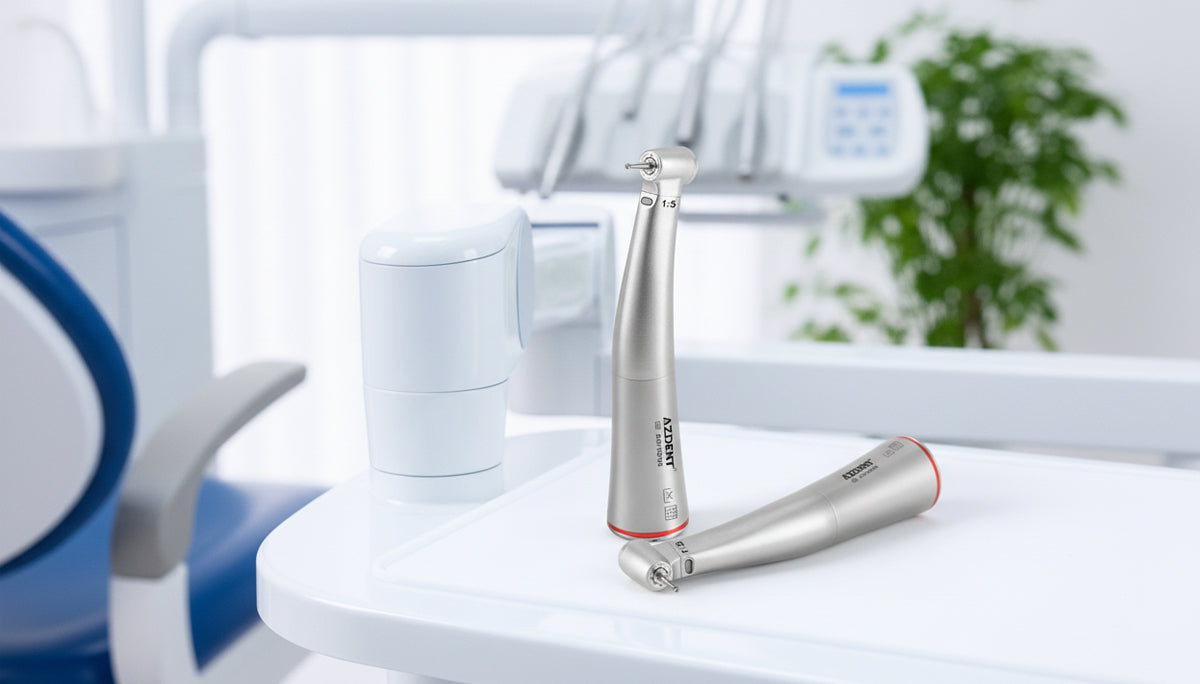
Choose a suitable electric contra-angle handpiece based on gear ratio for your specific procedures, connection type, head size, cooling systems, lighting and weight.
Here is the step-by-step criteria for choosing the right electric contra-angle handpiece for your clinic.
-
Select the Gear Ratio: Gear ratios determine speed and torque.
1:5: Speed increasers for crown prep, margins, and cutting.
1:1: Direct drive for general cavity prep and polishing.
16:1 or 20:1: Speed reducers delivering high torque for implants and endodontics.
1:4.2: It is primarily used for precision restorative dentistry, crown and bridge preparation, veneers, and light surgical workflows. Often combined with a 45° surgical head, it is highly effective for difficult-to-reach molar sections, wisdom tooth extraction, and precise bone removal.They are color-coded based on their gear transmission: Red indicates speed-increasing (e.g., 1:5 for high-speed cutting), Blue is 1:1 (direct transmission), and Green is speed-reducing for slower, high-torque work, (e.g., 16:1 or 64:1 ratios).
-
Check Motor Compatibility (E-Type Connection).
Most modern dental units and low-speed attachments follow the global ISO 3964 (E-Type) standard. As long as your electric micromotor features a standard E-Type coupling, you can seamlessly attach most brands.
-
Consider Head Size and Access
Handpieces come with varying head sizes, typically ranging from standard to miniature.
Choose miniature heads for improved visibility and easier access into tight posterior spaces or for pediatric patients. Standard heads are better suited for heavy-duty material removal where access isn't restricted.
-
Evaluate Illumination & Cooling
Illumination: Fiber optic lighting is essential for shadow-free visibility in deep cavities.
Cooling: Choose a model with multiple water ports (e.g., 3 or 4 ports) rather than a single port. Proper cooling prevents pulp damage and extends bur life, which is critical when working at high speeds with electric motors. -
Prioritize Ergonomics:
Electric contra angles tend to be heavier than air turbines. Choose lightweight, ergonomic models with push-button bur changers for easy operation. Look for lightweight materials like titanium bodies, textured or non-slip coatings (like PVD smart coats), and swiveling hose connections to minimize wrist fatigue during long procedures.
Choose a suitable electric contra-angle handpiece based on gear ratio for your specific procedures, connection type, head size, cooling systems, lighting and weight.
Features of AZDENT Electric Contra Angle Handpiece
AZDENT provides different types electric dental handpiece: 1:5/1:1/1:4.2/: Standard/Mini Head, E-type, Push Button, Inner/External Water, ect, Four Way Spray. Our electric handpieces can maintain a constant speed and lose no power during operation. Torque settings can also be adjusted with electric handpieces to suit various procedures. As they do not rely on air, speed increasing handpieces with electric motors also produce less aerosol than air turbines which is beneficial for infection control.
Support from AZDENT
At AZDENT, we don’t just provide handpieces, we help dental professionals make informed decisions that improve clinical results and workflow. Whether you’re opening a new practice, upgrading old equipment, or simply looking to expand your capabilities, our team can guide you in selecting the right handpieces for every procedure.
We offer in-depth consultations, product demonstrations, and access to training materials that simplify the selection process. From understanding the difference between electric handpieces to exploring compatibility with existing equipment, we’re here to make sure you get exactly what your practice needs.
AZDENT also provides repair and maintenance services, ensuring your handpieces remain in top condition.
If you're looking for more information, technical guidance, or immediate assistance, feel free to contact our team. We’re always ready to help with expert support and reliable service across the country.