

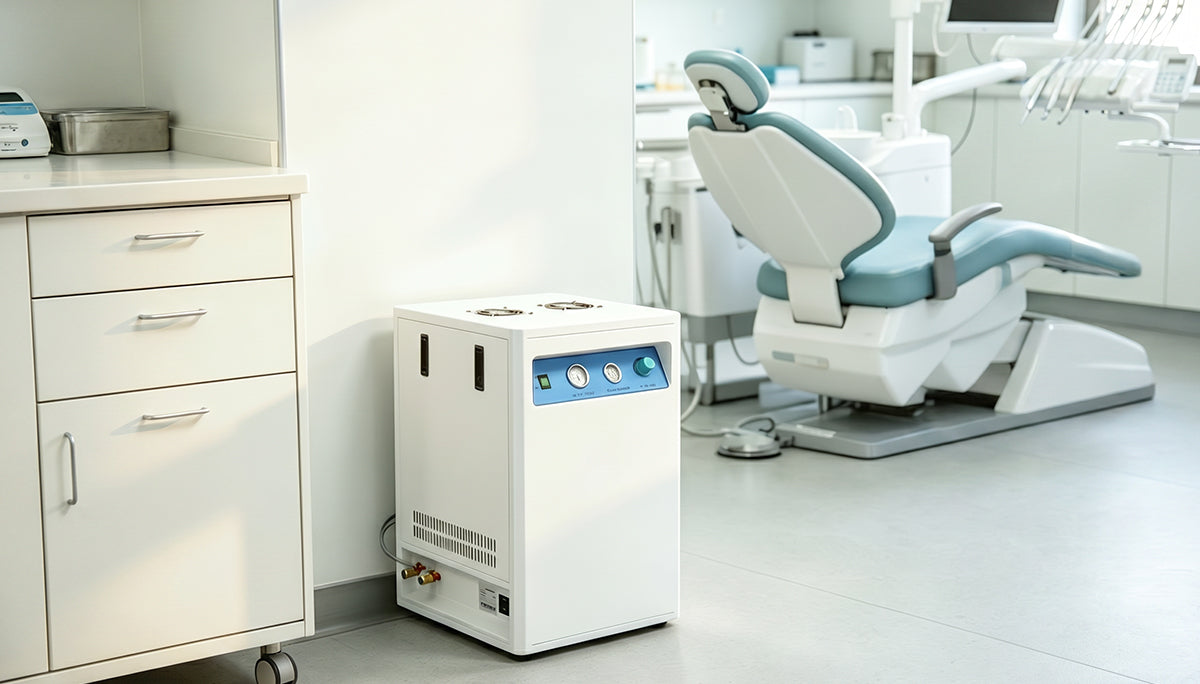
Air is just as vital as electricity or water in any dental office. Whether it’s powering handpieces, drying teeth, or cleaning, dental air compressors do the behind-the-scenes heavy lifting. They’re the force behind every drill, polisher, and scaler. Without your compressor, your whole operation can grind to a halt.
The Primary Functions of Air Compressors in Dental Practices
Dental air compressors are the heartbeat of dental offices, facilitating a wide range of procedures and maintaining high standards of hygiene and efficiency. The primary functions of compressed air in dental practices include:
Drying: Compressed air is used to dry teeth and surrounding tissues during procedures, a necessity for precise dental work, such as fillings and sealants.
Cleaning: High-pressure air effectively dislodges debris from dental instruments and surfaces, ensuring they are clean and ready for use. It is crucial for maintaining a sterile environment and preventing cross-contamination.
Irrigation: Compressed air is often mixed with water or dental solutions to create irrigation sprays. These sprays are used for rinsing debris and cleaning during procedures such as root canals and periodontal treatments, thereby enhancing the effectiveness of these treatments.
Cooling: Dental handpieces, particularly drills, generate heat during use. Compressed air cools these instruments, preventing overheating and minimizing patients’ discomfort.
Isolation: One of the most common uses of compressed air in dentistry is during the filling of teeth and maintenance of dental cavities. It helps isolate the area, keeping it dry and free from contaminants.
The Advantages of Oil-Free Air Compressors
In dental practices, the quality of air is of utmost importance. Contaminated air can pose serious health risks to patients and compromise the integrity of dental treatments. Traditional compressors, which use oil for lubrication, can inadvertently introduce oil particles into the air supply, leading to contamination. This is where oil-free air compressors, such as those offered by AZDENT, become essential.
AZDENT Dental Silent Oil Free Air Compressor
AZDENT oil-free air compressor is designed for dental applications, delivering clean, quiet, and reliable performance. Its advanced features include anti-rust and anti-microbial interior tank coating, ultra-low noise operation, and durable continuous-run capability.
Our dental oil-free air compressor provides 100% contaminant-free compressed air for dental chairs and labs. By eliminating lubricating oil in the compression chamber, it prevents oil mist or vapors from ruining restorative materials, protecting patient health, and keeping pneumatic instruments running smoothly
GA01, GA02
Oil-free operation with anti-rust and anti-microbial interior tank coating. Optional silent cabinet reduces noise to just 50dB+(A). Engineered for continuous operation with stable airflow output.
GA01(A) ,GA02(A)
DUAL-PRESSURE DISPLAY: Monitors tank pressure and lets you control the output in real-time
Oil-free operation with anti-rust and anti-microbial interior tank coating. Optional silent cabinet reduces noise to just 50dB+(A). Engineered for continuous operation with stable airflow output.
GA02X
Install an iron soundproof box, and the interior of the noise suppressor contains sound-absorbing cotton, temperature control sensors, and cooling fans. Clean air: Oil-free, anti-rust, anti-microbial inner coating. Low noise: Silent cabinet reduces noise to 45dB(A). Long service life: Continuous operation with stable air flow. Soundproof enclosure: Effectively isolates noise for quieter clinic environment.
A dental oil-free air compressor with a soundproof box is designed to provide clean, medical-grade air without the disruptive noise typical of standard compressors. These units are ideal for dental clinics and laboratories where a quiet, stress-free environment is essential for patient comfort.
Operation & Maintenance Guidelines
The air compressor automatically stops filling when the air pressure in the tank reaches 0.8 MPa, During product use, when the pressure drops to 0.5MPa, the machine will automatically restart and continue operating until the pressure returns to 0.8 MPa. This cycle repeats automatically.
Emergency Stop Button
Press the red button to immediately stop the machine in emergencies.
Pull the button upward to reset after resolving the issue.
Air Filter Maintenance
Clean the filter regularly to prevent dust entry and maintain suction efficiency.
Rinse the sound-damping sponge every 30-60 days.
Tank Drainage
Drain accumulated water every 3-5 days to maintain tank integrity.
Inflation Time Test
Recommended frequency: Monthly
Procedure:
1.Turn off power.
2.Open drain and air outlet valves.
3.Close both valves.
4.Restart the machine and record the time to reach shutoff pressure.
Note:
Normal inflation time: 3–4 minutes.
If exceeding 5 minutes, contact after-sales service
Conclusion
Air compressors are a fundamental component of dental practices, enabling a wide range of procedures and ensuring the highest standards of patient care. By choosing the appropriate compressor and ensuring proper filtration and storage, dental practices can enhance their operational efficiency, reduce downtime, and most importantly, protect the health and well-being of their patients.
We offer remote installation guidance and maintenance services for air compressors to ensure your product performs smoothly. Our professional team is ready to provide effective support tailored to your specific needs, helping you resolve any issues and address any concerns efficiently.
Contact Us
Email: service@azdentall.com
Phone/Whatsapp: +86 13203838215
FAQs
-
How to Cleaning Oil-Free Air Compressors?
Please keep the environment around the product clean. To unplug that electric wire before cleaning the unit. The process of cleaning as follows: firstly wipe the outer surface with a soft cloth stained with neutral detergent, then use a soft cloth to clean the machine again.
Warning: Do not use liquid or detergent containing flammable substances. -
What Should be Done if Oil-Free Air Compressors Produce Abnormal Noise?
First checkthat the black cylindrical silencer issecurely finger-tightened, then verifthe top-mounted black connectortube is fully inserted.
-
How to Change the Air Filter Core Oil-Free Air Compressors?
Air filter is installed on air inlet (silencer) of the motor to prevent the dust in the air from entering the air compressor and reduce noise. After being used for a period of time, the filter core in the air filter will get clogged. In a result sucking capacity of the air compressor will be reduced, therefore the filter core must be replaced regularly.
The way of replace is as follows: open the lid on the air filter, take out the old filter core, put in a new one, and then close the lid. -
Do Oil-Free Air Compressors Require Lubricating Oil?
The air compressor is the medical silent oil free air compressor, avoid to use any lubricating oil for it.
-
What is the Working Principle of AZDENT Dental Silent Oil Free Air Compressor?
The silent oil free air compressor is belonging to miniature reciprocating piston compressor. The motor single shafts drive symmetric distribution as a crank rocker mechanical structure. It is mainly working by piston rings; then it is also working by aluminium alloy cylindrical surface. During works, the piston rings make it lubricate without any lubricant. The compressor which works reciprocate through the crank rocker makes the cylinder cubage change periodically. The distribution structure of the horizontal double-cylinder makes air flow of compressor twice bigger than single-cylinder in a certain range. And that it makes the noise and vibration lower than of single-cylinder compressor; all these make the structure compact.
-
Why does the Medical Silent Oil Free Air Compressor Stop Working Suddenly?
If the medical silent oil free air compressor stop working suddenly (while voltage is normal), maybe for the air compressor work for long time, the overload protector work, this is the normal phenomenon. When the temperature of air compressor decreased, the air compressor will continue to work.
-
What Should be Done if the Pressure of Air Compressor is Over 0.8Mpa, But Compressor Do Not Stop Working?
please turn off the power, and to check the problem of pressure switch.